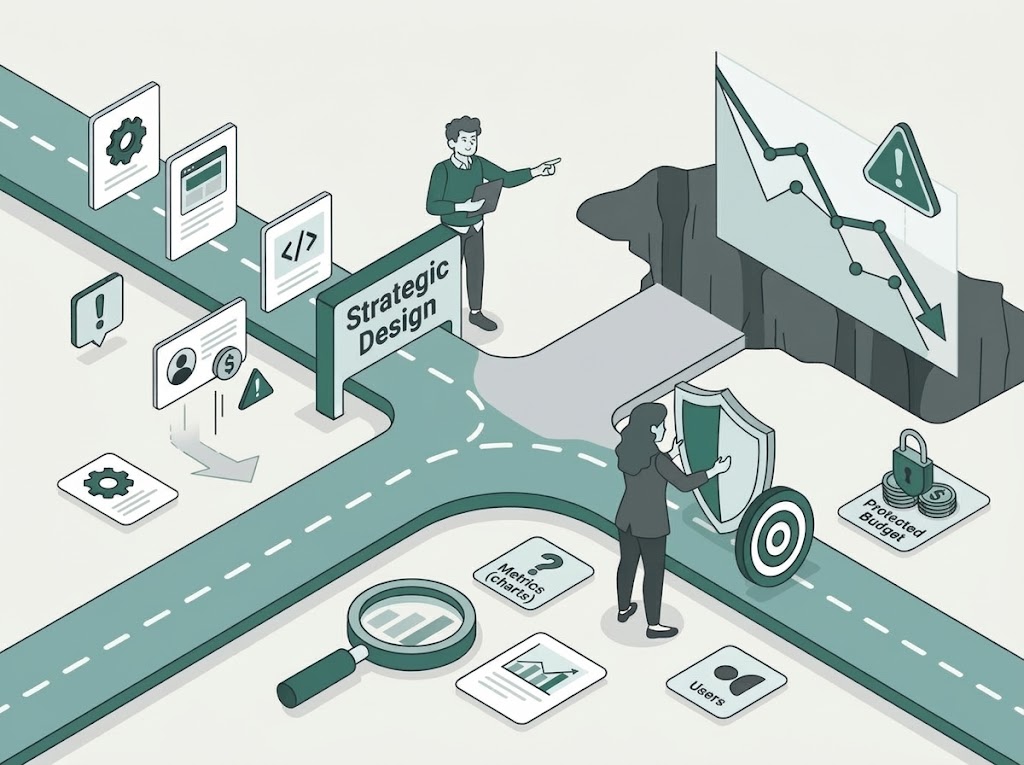
When budgets tighten, Design is often one of the first things to be cut. This happens so frequently because many companies view it merely as an external, decorative layer. From that perspective, the decision might seem reasonable at first glance. However, this perpetuates a long-standing bias against Design.
That bias mistakes a part of Design with the whole. The interface and the finish are what is visible at the end, but prior to that, decisions must be made regarding:
- What problem to solve?
- For whom?
- With what priority?
Those decisions are Design, too. When Design is cut across the board, you lose the very element that helps protect the budget.
Strategic Design is not the final layer that makes something look good. It is the discipline that helps decide what to build, what to halt, and where not to waste resources.
While 2026 is not considered a recession year, for those managing a budget, it feels quite similar. The Central Bank of Chile 1 lowered its GDP growth forecast for this year to a range of 0.25% to 0.75%. Globally, the IMF projects 3% growth—below pre-pandemic averages.
In this context, a board of directors shouldn’t ask, “How much does design cost us?” but rather, “How much does it cost us to get it wrong?”
What Is (And What Is Not) Strategic Design?
Strategic Design operates prior to the Interface Design stage. Its role is to reduce uncertainty in business decision-making using evidence drawn from users, the business, and the context.
It is not synonymous with UI or “running workshops”, nor is it merely a deliverable. The process remains essential—as I argued in a previous post on: Why Design Processes Still Matter and Will Continue to Matter. But the value of Strategic Design lies in the decision it enables, not the document it produces.
Simply put: while the execution of Design answers the “how,” Strategic Design answers the “what” and the “why”—before even considering the “how.”
Unfortunately, Design is often perceived as a cost because its results appear late in the process, once screens actually exist. What it prevented never shows up in any report: the functionality that wasn’t built, or the project that was halted in time.
How Strategic Design Protects the Business On a Tighter Budget
It Reduces the Cost of Getting it Wrong
Every feature built on an unvalidated assumption is a gamble. In a year of expansion, a lost bet can be absorbed; in a year of low growth, those losses weigh heavily on the bottom line.
Validating an assumption with a prototype and a few interviews with real users takes just a few days. Discovering that same error once the product is in production costs months of development, support, and reputation.
It Helps Prioritize When Everything Competes for the Same Budget
During a market slowdown, the Roadmap doesn’t shrink on its own. Every department continues to champion its own initiatives, and arguments are won through C-Level’s hierarchy or sheer persistence.
In this scenario, Strategic Design helps to change the question. It shifts from “What do we want to do?” to “What evidence do we have that this moves a metric that matters?” Asked at the right time, that question removes initiatives from the Roadmap that no one previously dared to question.
It Protects Your Existing Customer Base
When growth becomes more expensive, retention becomes fundamental. You have already paid the acquisition cost for a current customer; losing them due to avoidable friction means losing money twice over.
Friction rarely exists at a single touchpoint; it usually permeates the entire ecosystem. For example: channels designed separately (in silos), each with its own logic.
The Cost of Deciding Blindly
Cutting back on Design during a tight year might feel like a prudent decision; in practice. However, it means making decisions with less information—precisely in a context where every decision carries more weight.
The question isn’t whether you can afford to invest in Strategic Design; it’s whether you can afford to keep placing bets without it.
If you want an outside perspective on the bets in your Roadmap, take a look at how I work as a Consultant.