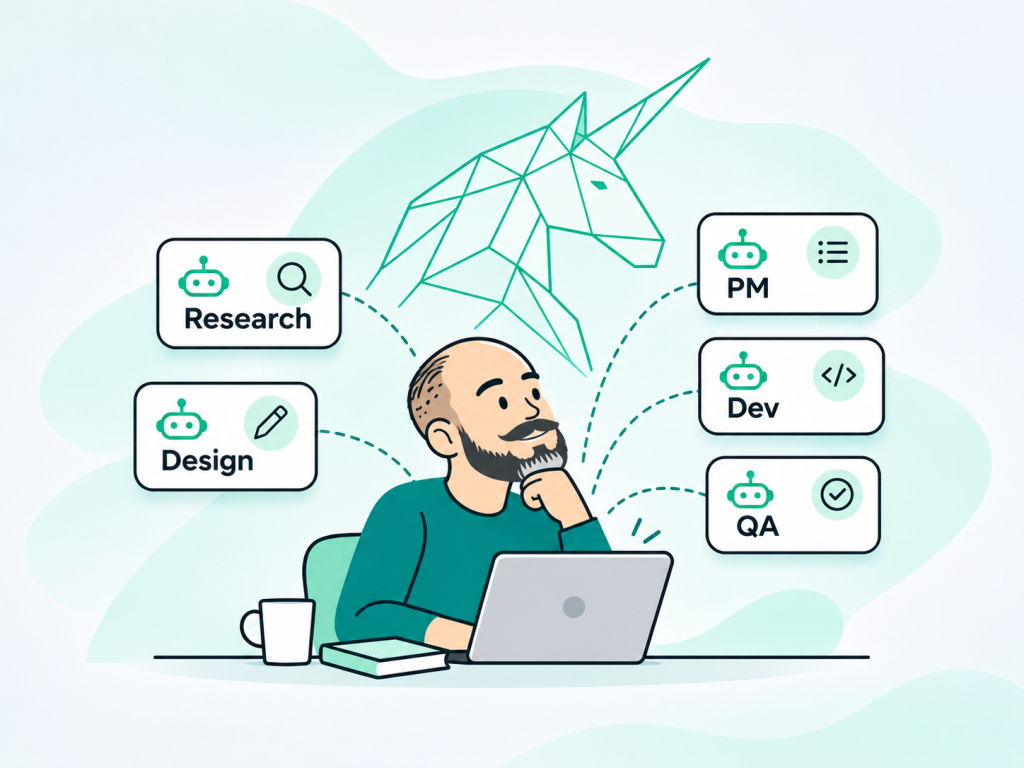
A few years ago, the market highly valued people who could wear many “hats” (e.g., Designer, Researcher, PM, Developer, QA, etc.). Companies were looking for someone who could take on several roles at once, because from a business perspective, that’s much cheaper than hiring several people to build a product design and development team.
People with this kind of profile were known as the “UX Unicorn” 🦄 (a mythical creature, and therefore, not real).
Agentic AI and the return of the UX Unicorn
Today, that somewhat hidden wish of the industry seems to be coming true thanks to the exponential growth of Artificial Intelligence, and more recently, of what’s known as Agentic AI.
A single person is no longer expected to know how to do everything. Now it’s enough for them to coordinate several AI agents that handle the Research, the Wireframes, the Code, or the User Testing. One person, assisted by multiple agents, gives the market the illusion that it has finally found the “UX Unicorn.”
And the illusion is tempting, because it’s partly true. AI does make it possible to carry out tasks from several roles, and much faster than before.
The problem that never went away
However, that illusion runs into a problem that has never fully gone away: the loss of the different perspectives a multidisciplinary team brings.
When a Developer reviews a flow, they notice things I don’t see. The same happens with someone from the business side, QA, or UX Research. Each discipline brings its own questions, its own red flags, and its own criteria for what “good” looks like.
Today we supposedly have a “UX Unicorn” who can handle several product design tasks by leveraging AI. But what happens when we lose those multiple views of the same challenge or business problem?
What’s left is a single point of view, amplified by several tools. If that point of view has a blind spot, the agents work from that same blind spot.
AI doesn’t push back on your decisions
While I think AI can help you do the work of several roles, it won’t push back on a design decision the way a real person looking at the problem from another discipline would.
An agent responds to what you ask. If you ask it to validate your proposal, it will usually validate it. A real human being, on the other hand, can argue with you. For instance, he/she can say:
That can’t be built, that doesn’t serve the business goals, or, users won’t understand it.
That kind of discussion is what brings value to multidisciplinary teams. Sometimes these discussions are uncomfortable and can slow the process down a bit, but that’s where an idea gets tested before it reaches the end user.
Let’s not throw out the discussion
I don’t think the problem is using AI. The problem is assuming that, because one person with agents can produce more, we no longer need anyone to tell them, with concrete arguments and from their own professional experience: “I’m not convinced.”
AI can speed up execution, but diversity of judgment still comes from different people looking at the same problem, and that is something we shouldn’t remove from the Product Design process.